First year puppy costs
By the PupCost editorial team · Last verified November 18, 2026
Year one stacks everything at once: getting your dog, setup, vaccines, spay or neuter, training, and the first year of food and care. Here is the full picture, with real numbers.
The short answer: what year one really costs
In PupCost's model, a first year runs from about $3,600 for a small dog to about $6,200 for a giant one, at national average prices and including average insurance. A medium dog, the size most families picture, lands near $4,240. That is not a scare number; it is two honest parts added together. The first part is the steady monthly cost of food, routine vet care, grooming, supplies, and insurance, roughly $195 to $365 a month depending on adult size. The second part is the one-time stack that only year one carries: about $1,150 to $1,800 for setup, the puppy vet series, spay or neuter, and starter training.
Published studies land in the same neighborhood. The ASPCA's pet care cost chart breaks first year spending into the same categories we use, and Rover's True Cost of Pet Parenthood report finds first year totals well above what most new owners guess. The gap between the guess and the real number is exactly why this guide exists.
A worked example: one medium puppy, month by month
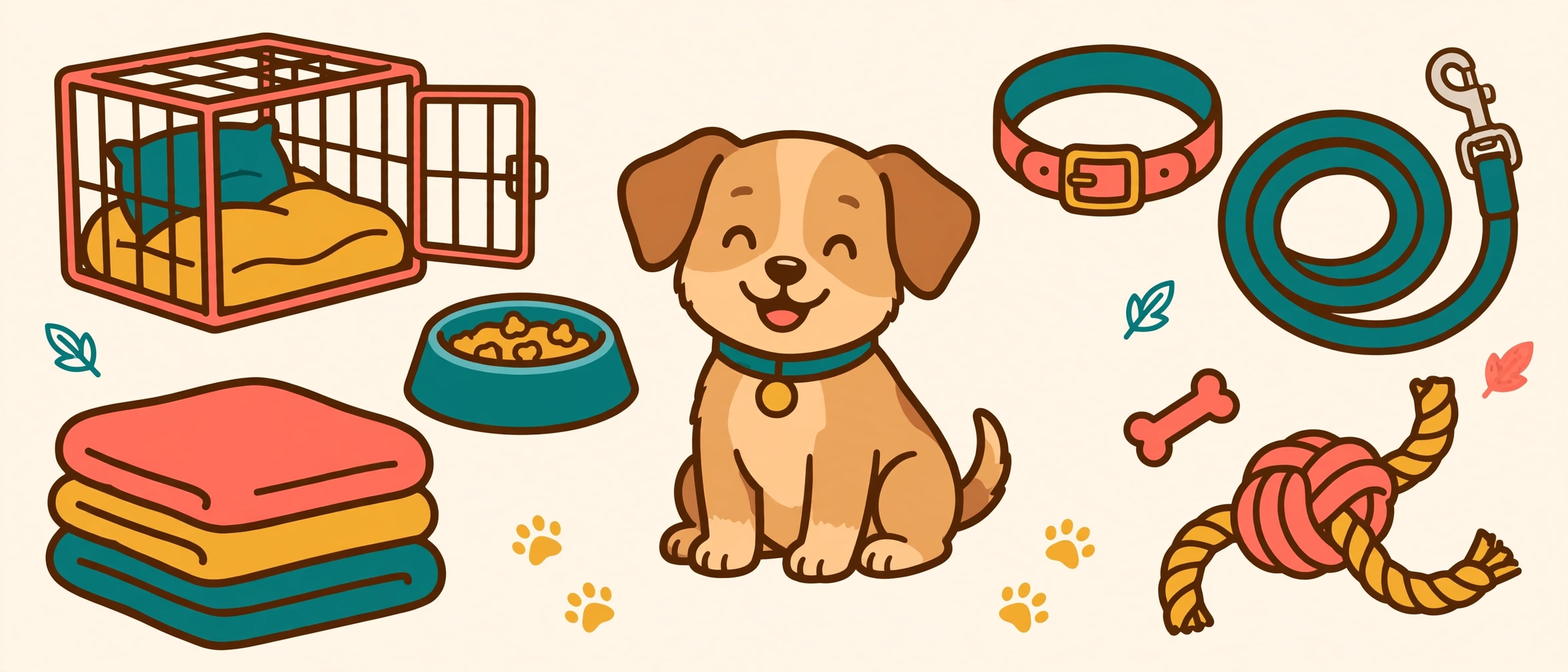
Picture a medium puppy, expected to reach about 40 lb, in a state at the national average. Before she comes home, the starter kit costs about $380: a $65 crate bought at adult size, a $40 bed with a washable cover, $18 of bowls, a $20 lead, an $18 collar with an ID tag, $25 of grooming basics, $30 of toys, and the first bags of food and training treats. Her first vet stretch, the puppy vaccine series, parasite prevention, and microchip basics, plus spay surgery later in the year, sits inside the roughly $1,350 one-time total, alongside about $180 for a group training course.
After that, the months settle down: about $65 of food, $60 of routine vet care spread across the year, $40 of grooming, $30 of supplies and replacements, and about $46 of average insurance, roughly $241 a month. Add it up and year one is about $4,240, while a typical year after that is about $2,890. Same dog, same love; year one is simply carrying the furniture.
What makes one first year pricier than another
Four things move the first year total more than everything else combined. Adult size is the biggest: food, medicine doses, crates, and beds all scale with the dog, so a giant puppy's year one can cost close to double a small puppy's. Breed health is next: a French Bulldog or Bulldog puppy carries higher vet and insurance lines from the start, because breathing and skin care are part of the breed's honest picture. Where you live matters too: PupCost's state index runs from 0.88 in Mississippi to 1.22 in Hawaii, so the same puppy can cost several hundred dollars more or less in year one depending on the state.
The fourth factor is how your dog joins the family. An adoption fee from a shelter is usually far lower than a breeder's price, and an adult dog often arrives already vaccinated and spayed or neutered, quietly deleting several year one lines. None of these choices is the right one for everyone; they are just the levers, and it helps to know which lever does what before you pull it.
Practical steps: a gentle first-year plan
- Run the calculator for your breed and state before the dog comes home, and write down the first year and monthly numbers.
- Buy the starter kit once, at adult size where it applies: one crate with a divider panel, not three crates your puppy outgrows.
- Book the first vet visit in the first week, and ask the clinic for the full puppy series schedule and its prices, so the year's vet costs arrive as a calendar, not a surprise.
- Decide on insurance while your puppy is young and has no pre-existing conditions, because that is when a policy covers the most.
- Start the reserve habit in month one, even $25 to $50 a month, in a separate pot for the lumpy things: boarding, a chewed lead, an unplanned visit.
- Borrow before you buy where you can; puppies outgrow gear and opinions fast, and a borrowed second bed beats a bought one gathering dust.
- At month six, compare what you actually spent with the plan and adjust kindly. Every family drifts a little; the plan is there to catch the drift, not to judge it.
Common first-year mistakes
The most common mistake is budgeting only for the puppy price and the first bag of food, then meeting the vet series, the crate, and the training course as surprises. The second is skipping the emergency reserve because the puppy looks healthy; puppies are also the age group most likely to eat a sock, a toy, or something from the yard, and foreign body surgery is one of the most expensive first year events there is. The third is buying everything in puppy size: three crates, two beds, and a wardrobe of tiny collars can quietly add a few hundred dollars that one adult size purchase would have avoided.
A quieter mistake is putting off the insurance decision until after the first diagnosis. Insurance never covers pre-existing conditions, so a knee, allergy, or heart finding that appears before you enroll stays yours for life. You may still decide insurance is not for you, and that is a fair choice; just make it on purpose, early, rather than by accident, late.
The bottom line
Year one is the most expensive year of a dog's life, and it is also the most predictable: roughly $3,600 to $6,200 in our model, built from a monthly base of $195 to $365 plus a one-time stack of $1,150 to $1,800. Year two usually drops by about a third, which is why so many families say the second year feels like a relief. See the number now, spread it kindly, and year one becomes what it should be: busy, joyful, and already paid for.
Sources: AKC, ASPCA cost categories, Rover, Synchrony Bank, APPA, NAPHIA. Last verified November 18, 2026.